
CONNECTED & ADAPTIVE LEARNING INTELLIGENCE SYSTEM
Research Project Scope
From kindergarten to graduate school, one of the key ways artificial intelligence will impact education is through the application of greater levels of individualised learning. Some of this is already happening through growing numbers of adaptive learning programs, games, and software. These systems respond to the needs of the student, putting greater emphasis on certain topics, repeating things that students haven’t mastered, and generally helping students to work at their own pace, whatever that may be. This kind of custom tailored education could be a machine-assisted solution to helping students at different levels work together in one classroom or with teachers facilitating the learning and offering help and support when needed or combined.
Adaptive learning has already had a huge impact on education across the world, and as AI advances in the coming decades adaptive programs like these will likely only improve and expand.
The proposed research project is not aimed at finding different options of how artificial intelligence can replicate the human learning style or replace teachers in class rooms. The aim is to understand how Augmented humanoid learning can make use of human learning behaviours and determine the learning path of a specific learner based on its legacy data of millions of students with the similar persona and behaviour to predict the learning path of new learner and then applying intelligent learning algorithms to produce highly intelligent and tailor made individualised learning curriculum for the learner. This research project aims at developing algorithms, patterns, products and channels for tracking & tagging of student learning style, mental age and learning journey to convert collective learning behaviours into connected learning intelligence (CLI) hence consolidating all of these into a connected, research-based education operating system.
Identification of learning behaviours based on tracking & processing of personal profile, learning issues, mental age, learning styles of group of children (learners). Development of Human Intelligence (HI) based Swarming AI models to convert behavioural learning patterns into connected & collective learning intelligence. Prediction and pattern engine works on persona data sample sets (e.g. age, gender, health condition, disability, family background etc) and internal factors (e.g. learning issues, mental age, learning style) to analyse learning patterns for intelligent curriculum development, self-paced lesson plans and learning assessment.
Problem Statement
The research project will be addressing a wide array of challenges faced by current age educational systems, pedagogy, curriculum design, learning outcomes, instruction relays and pathways and scalability:
Research Project Phases
IDENTIFICATION
Key Problem Areas: Exploration, identification and verification of key challenges affecting modern educational systems
Infrastructure:
Software Components: AWS SageMaker, AWS Rekognition, AWS Comprehend, Matlab
Hardware Components: AWS EMR Cluster, AWS Redshift Cluster, Elasticsearch Cloud
Data Pipeline Components: Surveys, interviews, on-site observations, literature review, interventions, mock learning environment testing
AUTOMATION
Instructors Augmentation: Assist learners with self-direction, self-assessment, teamwork and more
Infrastructure:
Software Components: Algorithms, patterns analysis, Amazon Polly, Amazon Transcribe
Hardware Components: Compute intensive Amazon Cloud
Data Pipeline Components: Surveys, interviews, on-site observations, literature review, interventions, mock learning environment testing, online class sessions
SWARMING
Interaction Data Analysis: Bring together the vast amounts of data about individual learning, social contexts, learning contexts and personal interests, interaction behaviours assessment.
Infrastructure:
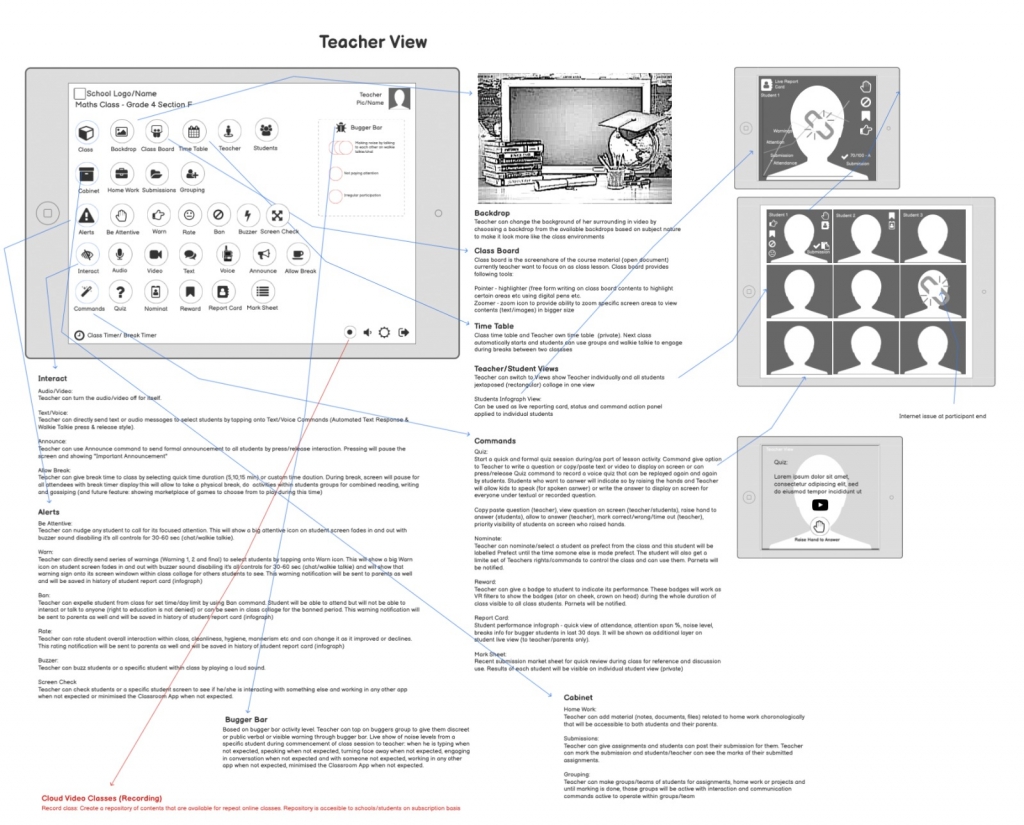
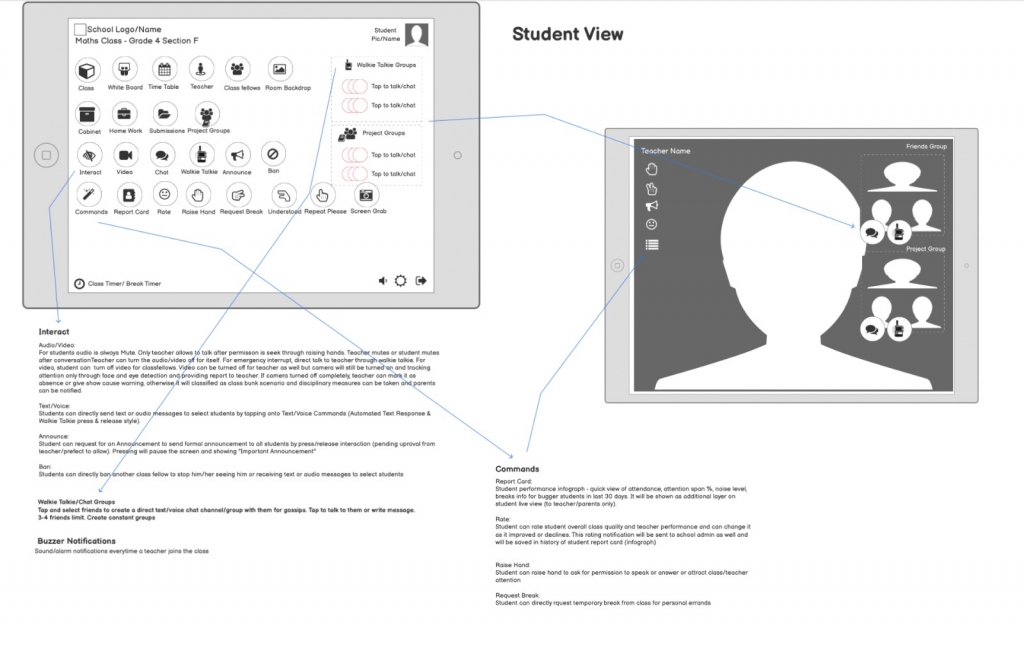
Software Components: Virtual Class Room Application
Hardware Components: Dev & Analysis Environment
Data Pipeline Components: Online class sessions
PRODUCTION
Applications Development: Applications for relaying instruction, automating the learning pathway designs, collection data samples and tracking outcomes
Infrastructure:
Software Components: Education Operating System, Contents Production System, Assessment Systems, Interaction Systems
Hardware Components: Dev & Analysis Environment
Data Pipeline Components: Sessions, interactions, manual submission of contents
The Solution
A suite of researched oriented digital learning applications for new disruptive class rooms where child should not struggle to match the pace of teacher for learning, instead each child should have the flexibility of learning at his/her own mental learning pace and getting more learning in same time through fast track learning tools and methodologies, getting assistance in their learning issues and validating the learning outcome they should have with respect to their age and learning levels using their digital addiction as drive for their learning.
Features Highlights
- Identify learning issues in normal child e.g dyslexia, dyscalculia, dysgraphia, on-sit behavior, focus issue, eye sight weakness, color blindness, hearing issue, slow mental processing, depth issue
- Measure the severity & complexity of learning issues
- Validation of learning outcomes with the current learning level to verify the learning issues
- Measure the general learning progress with respect to age & learning level (clarity of concepts of learning)
- Assist teachers with automated learning material for learning issues & iterative through focused group learning – one group of child with one learning issue – enforced role play fast track learning without the need of individual allocated time for each child
- Immersive, fun, interactive fast track learning (3x more learning in same time) with focus on concepts understanding than learning grading through marks
- Use the digital addiction as drive for learning in teacher supervised not teacher dependent learning environment
- Progress tracking for parents
Mechanism
- Child profile data (age etc)
- Child issues assessment (manually (phase 1) or automated through activities phase 2)
- Learning Activities (to determine learning styles and mental age)
- Sequential learning concepts + activities using stack in/stack out, stack up, stack down methodologies
- Path identification (mental age, learning style and learning challenges based learning outcome blocks based sequential learning path)
- Individualized lesson plan (intelligent curriculum)
- Intelligent Lesson plan (N primary concepts memory, N secondary (next), N tertiary (prev) and N auxiliary concept (foundational – future) weak/strong concept identification
- Stack in new concept if existing strong
- Stack up weak concepts
- Stack down strong concepts
- Stack out proven concepts based on learning mental age
- Learning Outcome Chain: Learning outcome arrangement & linking (primary outcomes & auxiliary outcomes = secondary outcomes, tertiary outcomes)